
Solar Battery Guide for Victorian Homeowners: Everything You Need To Know
Solar Battery Guide for Victorian Homeowners: Everything You Need To Know
Key Points:
- Solar batteries help you store excess solar power instead of sending it to the grid, giving you control over when and how you use your energy.
- Feed-in Tariffs (FiTs) have dropped by over 98%, meaning it’s no longer financially smart to export your solar without storage.
- Storing and using your own solar can save you over $1,200 per year which is far more than selling it back to the grid.
- Battery prices typically range from $10,000–$15,000, but federal rebates of up to 30% can bring that down to $6,500–$10,500.
- The rebate is applied as an upfront discount, and will reduce each year until 2030, so early adopters save more.
- Eligibility is simple: You need a compliant solar system, approved battery brand, and a CEC-accredited installer (like us) who applies for the rebate on your behalf.
- Payback periods range from 7–12 years, depending on usage habits especially if you use energy at night.
- A solar battery isn’t for everyone, but it’s ideal if you want to reduce grid reliance, offset peak rates, or boost energy resilience.

Thinking About A Solar Battery? Here’s What You Need To Know
As electricity prices continue to rise and feed-in tariffs fall to record lows, many homeowners in Victoria are now considering whether solar battery storage makes sense for their property.
Once considered an optional upgrade, battery storage is quickly becoming a core part of a modern home energy strategy.
Government incentives are also playing a role. As of 2025, eligible households can access federal rebates that cover up to 30 percent of the installed cost. This has helped make batteries more financially accessible, particularly for households that already have solar panels or use significant electricity during the evening.
However, a battery is still a major investment. Choosing the right system requires understanding key details including capacity, performance, efficiency, warranty coverage, and rebate eligibility.
This guide is designed to help Victorian homeowners evaluate the opportunity with clarity. You will learn:
- What solar batteries do and how they work
- How much they typically cost and what kind of savings are realistic
- What rebates are currently available and how to claim them
- Whether a battery makes sense for your household’s energy profile
If you are serious about making your solar system work harder and reducing your reliance on the grid, this guide is a practical place to begin.
How A Solar Battery Saves You Money
Solar batteries allow you to maximise the value of your solar generation by storing excess daytime energy for use during peak evening hours (when electricity from the grid is at its most expensive).
Instead of exporting surplus solar to the grid at feed-in tariff rates that have now dropped as low as 0.04 cents per kWh, a battery enables you to retain and consume your own energy. This reduces the volume of electricity you need to purchase from the grid, which can be upwards of 30 to 45 cents per kWh during peak demand periods.
By shifting your solar energy use from low-value export to high-value consumption, a battery provides:
- Tariff arbitrage: If you are on a time-of-use electricity plan, you could avoid buying electricity at inflated rates and eliminate the loss incurred from selling energy at minimal feed-in rates.
- Peak demand offset: Batteries discharge during periods of high usage and high tariffs, lowering your total electricity bill.
- Improved self-consumption: Homeowners typically self-consume only 20–30% of their solar generation without a battery. With a well-sized system, this can increase to over 80%.
- Protection from grid volatility: Some battery models include backup capabilities, offering energy security during blackouts or outages.
For households with consistent evening usage such as those charging EVs, heating or cooling at night, or working from home, this shift can significantly reduce annual energy costs while providing long-term energy independence.
With a well-sized solar and battery system, it’s possible to eliminate electricity bills entirely with minimal grid imports and strategic solar exports offsetting daily supply charges.
The Real Cost Of Selling vs. Storing Your Solar Power
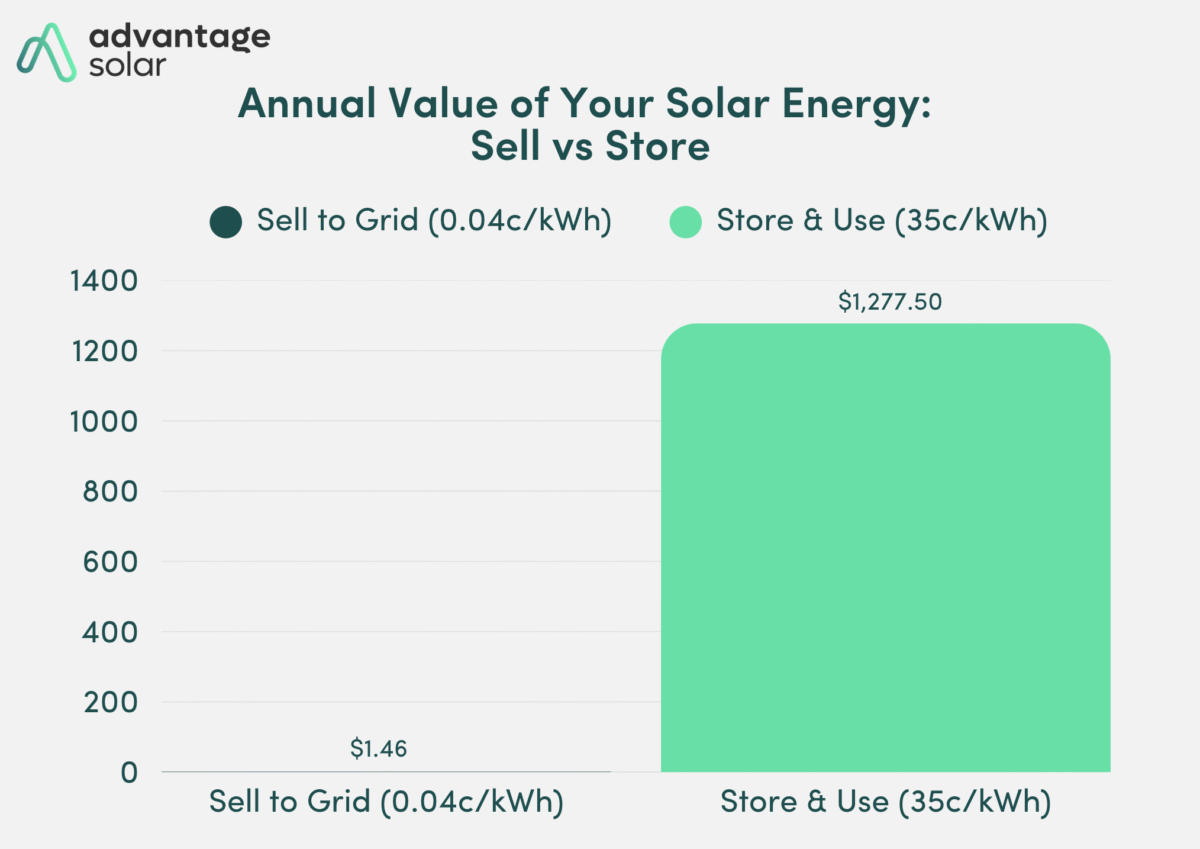
Victorian households are generating more solar energy than ever. But without a battery, most of that excess power gets exported to the grid for just a fraction of its true value. From 1 July 2025, the minimum flat feed-in tariff (FiT) in Victoria is just 0.04 cents per kilowatt-hour, meaning you’re paid next to nothing for exported solar. Some energy retailers may offer slightly higher FiTs, but they’re still a fraction of the real value of that power.
By comparison, using that same energy from a battery during peak evening hours (when grid electricity costs 30 to 45 cents per kilowatt-hour) unlocks dramatically greater savings.
Let’s look at the difference in real numbers.
Without a Battery: Selling Back to the Grid
Let’s say your solar system exports 10 kWh of excess electricity per day.
Scenario 1: Old FiT Rate (e.g. 3.3 cents per kWh)
- 10 kWh x $0.033 = $0.33 per day
- Monthly: $0.33 x 30 = $9.90
- Annually: $0.33 x 365 = $120.45
Scenario 2: Current FiT Rate (e.g. 0.04 cents per kWh)
- 10 kWh x $0.0004 = $0.004 per day
- Monthly: $0.004 x 30 = $0.12
- Annually: $0.004 x 365 = $1.46
That’s a 99% drop in the money you get back from selling energy to the grid from over $120 a year to barely enough for a coffee.
With a Battery: Storing Power Instead of Selling It
Now imagine storing that 10 kWh/day of excess solar in a battery and using it during peak evening times, when grid electricity costs $0.30–$0.45 per kWh.
Let’s use a conservative rate of $0.35 per kWh:
- 10 kWh x $0.35 = $3.50 saved per day
- Monthly: $3.50 x 30 = $105
Annually: $3.50 x 365 = $1,277.50
The Difference?
Scenario
Annual Value
Sell to Grid (Old FiT)
~$120
Sell to Grid (New FiT)
~$1.50
Store & Use with Battery
$1,277.50
Bottom Line:
With FiTs at historic lows, storing your solar power instead of exporting it just makes sense. A solar battery gives you back control and makes your solar investment work harder for you.
What Rebates Are Available And Who’s Eligible?
Here’s where it gets exciting: the federal government is offering a solar battery rebate through the Small-scale Renewable Energy Scheme (SRES).
What does that mean for you?
- You can get around 30% off the full installed cost of a battery
- The rebate amount is based on usable kWh (battery size)
- The rebate amount is scheduled to gradually reduce each year until 2030 (get in quick for the best rebates).
- The rebate is applied as an upfront discount (no waiting around for money back)
- Your approved solar battery installer (that’s us) handles all the paperwork on your behalf for free
Eligibility basics:
- You live in Australia (Victoria’s included)
- You’re installing the battery with an eligible solar system
- The product and installer meet Clean Energy Council (CEC) standards
What Does A Battery Cost And Is It Worth It?
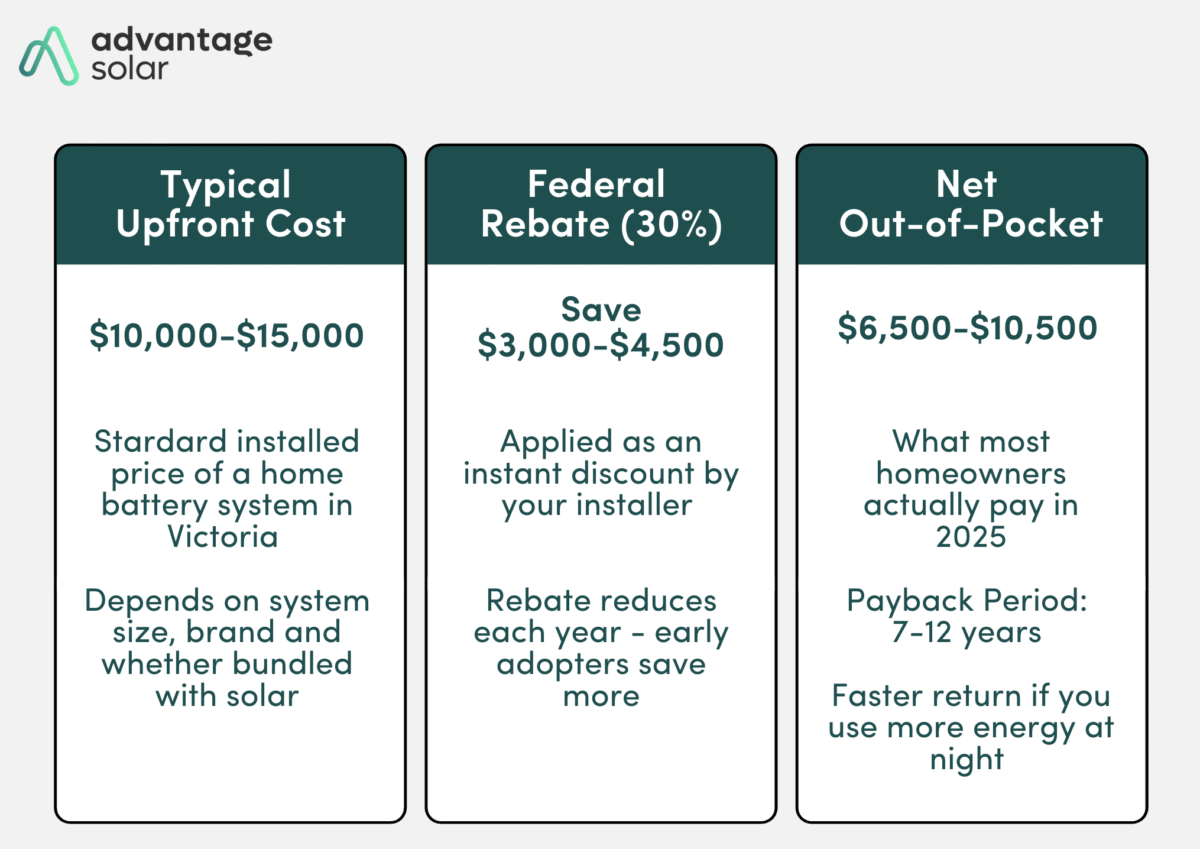
Here are the numbers:
Typical costs (before rebate):
Most home battery systems in Victoria fall between $10,000–$15,000, depending on capacity, brand, and whether it’s part of a new solar install or an add-on.
After the Federal Rebate (about 30%):
You’re looking at roughly $6,500–$10,500 out of pocket, depending on your system.
Payback period:
Battery payback periods vary but usually range from 7–12 years. The more energy you use (especially in the evening), the faster your savings add up.
It’s not just about return on investment. It’s about future-proofing your home and staying protected against rising grid costs, shrinking FiTs, and even blackouts (with certain batteries that offer backup power).
Should You Get A Solar Battery?
Here’s how to know if a battery could be worth it for your home:
It might be right for you if you:
- already have solar panels or are planning to install them
- use power at night (EV charging, WFH, appliances, etc.)
- want to reduce reliance on the grid
- care about protecting yourself from power price hikes
- want greater energy independence and resilience
Ready To Take the Next Step?
A solar battery can future-proof your home, slash your bills, and give you back control but only if it’s the right one, installed the right way.
Need help figuring it all out?
We’ll help you figure out if a battery is worth it, check your rebate eligibility, and guide you every step.
Find out more about whether solar batteries are right for your home.
Table of Contents